February 27, 1930 Vancouver
I have been sick and I have had a shock, my Doctor also my wife know what kind of a shock I had.
A strange thing happened: I have never related my war experience to anyone, I have'nt been able, it has been so dim, and I have been dumb. I have related odd incidents when the spirit moved me, but when asked for experiences I was silent and could not talk.
Once when up for a medical Board at Shaughnessy Hospital the Dr. I think Dr. Manchester after a gruelling examination said suddenly give me your record the actions you were in and places you were at. I tried, step by step he led me, but I could'nt remember scarcely a thing I trembled and shook and I guess he put me down for a fake. It was unfair.
Since last Sunday I have been back to the War, all over France have I been, to Belgium, back again, over the top in rest camps names leaped out at me, faces remembered, incidents, conversations actions trips nearly all have come back to me clear as it has never been before.
All Sunday night I tossed and fought part of Monday and the night again all Tuesday though I went to work I was on the Battle Front, that night I slept, I woke early refreshed but my thoughts shot back to the War Zone, all day Wednesday, my wife would speak to me or the boys, yes I would say, getting no other answer they would speak again with an effort I would come back, my thoghts were miles away. Back to France I would go again. I slept a little and woke around 2am, back went my mind to France. Thursday I worked while my mind followed the war and tonight I am starting to write what I can remember the boys will be glad to read it when they grow up perhaps.
Dliberately I went to the harvest fields in 1915 knowing full well the land would give one good health, it had always done so. I was going to the war.
Thee was lots of time I knew from South African experience that the British would not get into their stride for two years at least.
It was a big crop year, men were getting scarce and wages were high. I took in the haying in B.C. and Alberta and when the crop was ready so was I.
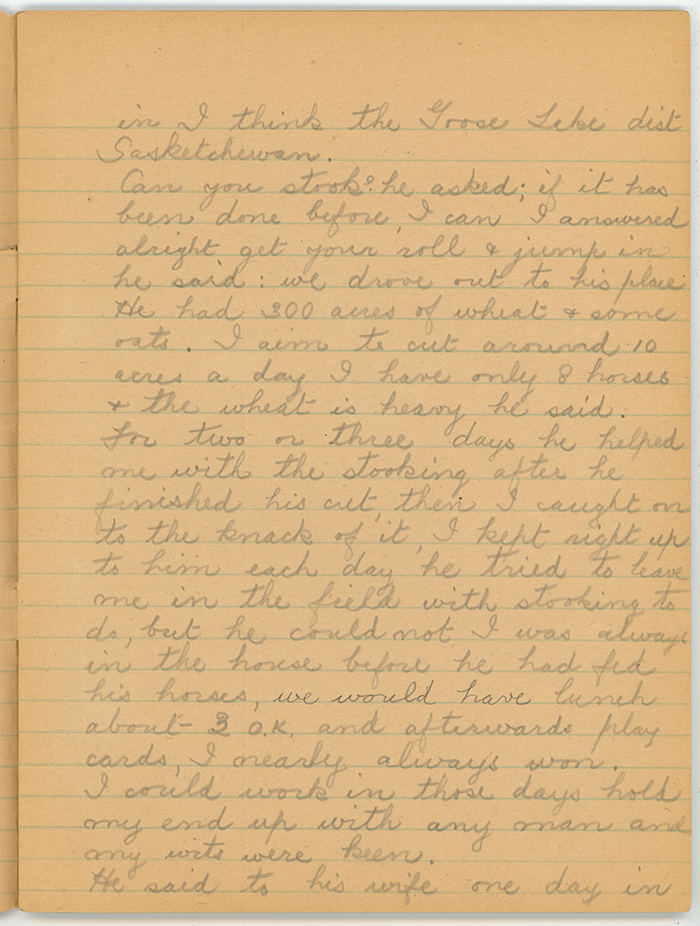
I hired out to an American a big square man about 50 years old in I think the Goose Lake dist. Sasketchewan.
Can you stook? he asked; if it has been done before, I can I answered alright, get your roll and jump in he said: we drove out to his place, He had 300 acres of wheat and some oats. I aim to cut around 10 acres a day I have only 8 horses and the wheat is heavy he said. For two or three days he helped me with the stooking after he finished his cut, then I caught on to the knack of it, I kept right up to him each day he tried to leave me in the field with stooking to do but he could not. I was always in the house before he had fed his horses, we would have lunch around 2 O.K. and afterwards play cards, I nearly always won. I could work in those days hold my end up with any man and my wits were keen.
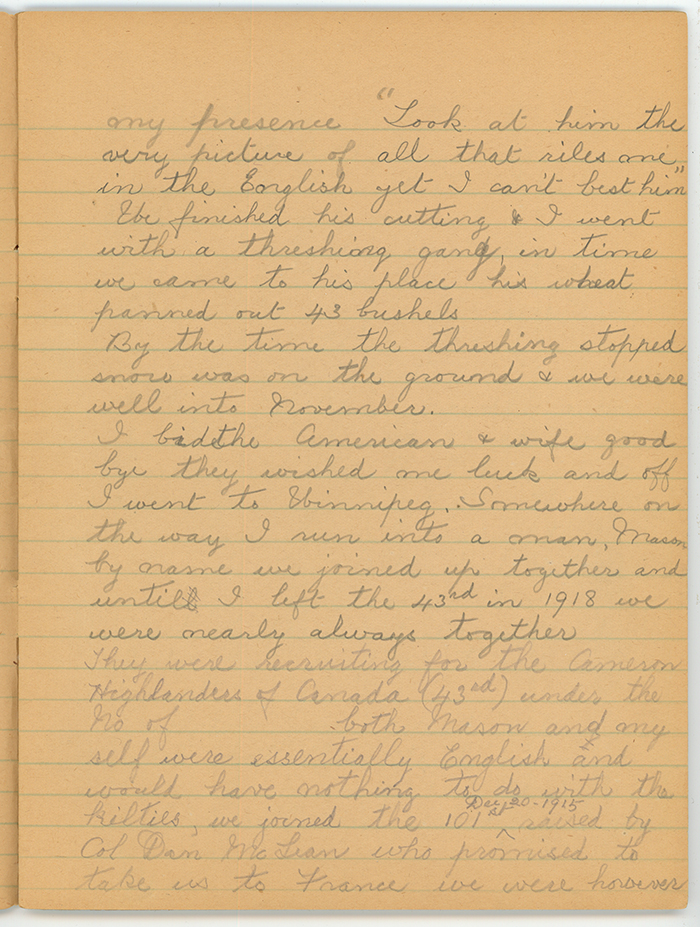
He said to his wife one day in my presence "Look at him the very picture of all that riles me in the English yet I can't best him". He finished his cutting I went with a threshing gang, in time we came to his place his wheat panned out 43 bushels.
By the time the threshing stopped snow was on the ground and we were well into November.
I bid the American and wife good bye they wished me luck and off I went to Winnipeg. Somewhere on the way I ran into a man, Mason by name we joined up together and until I left the 43rd in 1918 we were nearly always together.
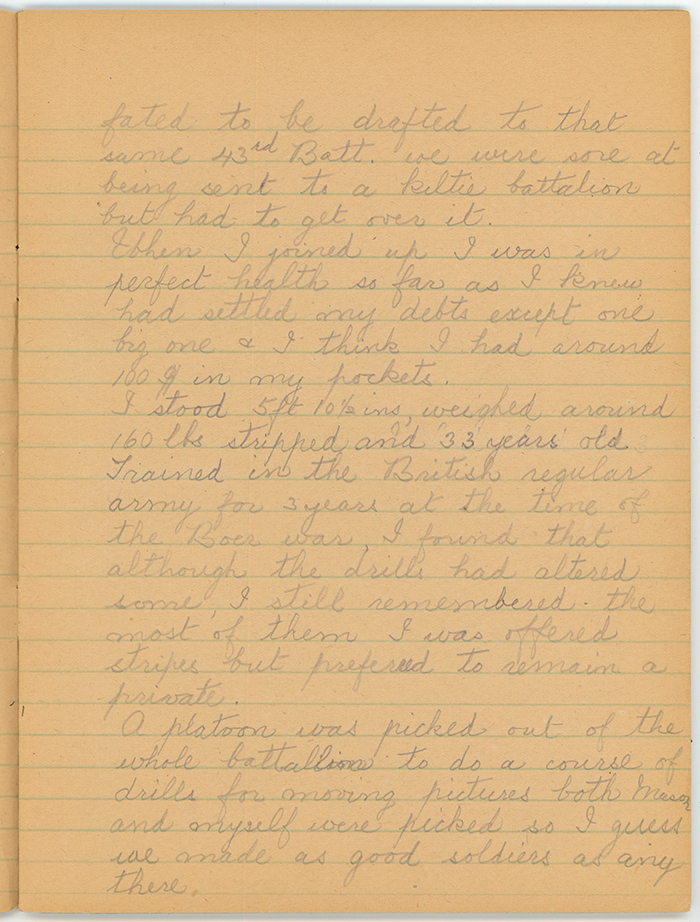
They were recruiting for the Cameron Highlanders of Canada (43rd) under the No of________ both Mason and myself were essentially English and would have nothing to do with the kilties. We joined the 101st, December 20-1915 raised by Col. Dan McLean who promised to take us to France we were however fated to be drafted to that same 43rd Batt. we were sore at being sent to a kiltie battalion but had to get over it.
When I joined up I was in perfect health so far as I knew had settled my debts except one big one and I think I had around 100$ in my pockets.
I stood 5ft 10-1/ 2 ins, weighed around 160 lbs stripped and 33 years old. Trained in the British regular army for 3 years at the time of the Boer War. I found that although the drills had altered some, I still remembered the most of them. I was offered stripes but preferred to remain a private.
A platoon was picked out of the whole battalion to do a course of drills for moving pictures both Mason and myself were picked so I guess we made as good soldiers as any there.
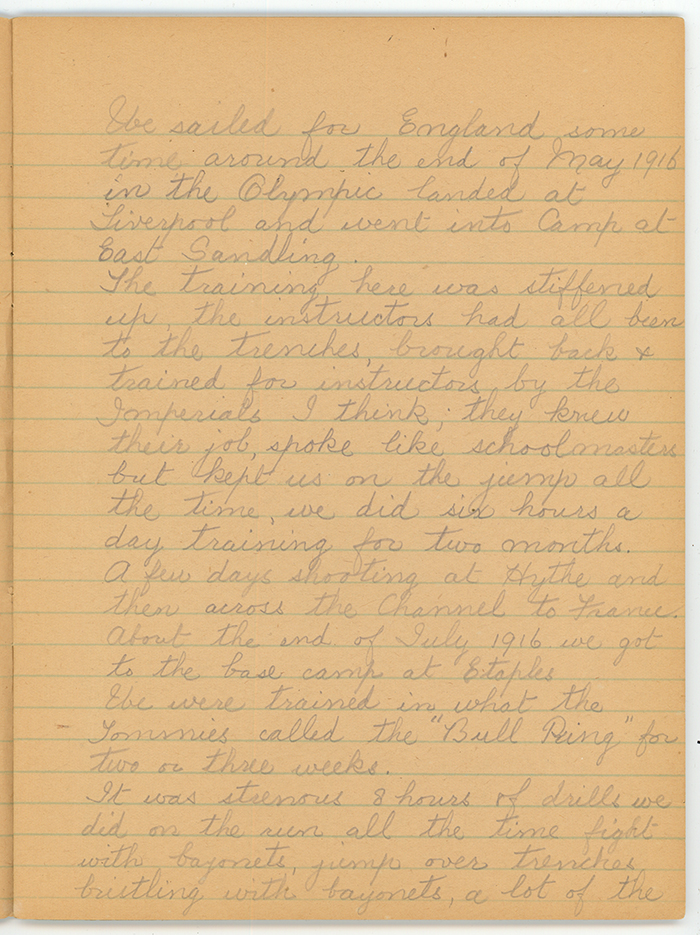
We sailed for England some time around the end of May 1916 in the Olympic, landed at Liverpool and went into Camp at East Sandling.
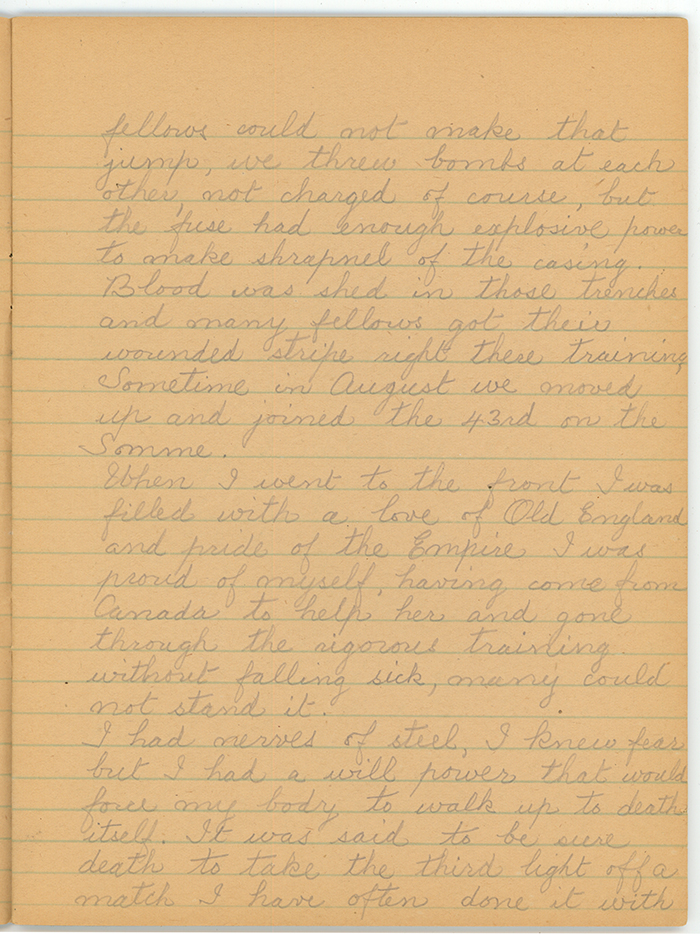
The training here was stiffened up, the instructors had all been to the trenches, brought back and trained for instructors by the Imperials I think; they knew their job, spoke like schoolmasters but kept us on the jump all the time, we did six hours a day training for two months. A few days of shooting at Hythe and then across the Channel to France. About the end of July 1916 we got to the base camp at Etaples. We were trained in what the Tommies called the "Bull Ring" for two or three weeks.
It was strenous 8 hours of drills we did on the run all the time fight with the bayonets, jump over trenches bristling with bayonets, a lot of the fellows could not make that jump, we threw bombs at each other, not charged of course, but the fuse had enough explosive power to make shrapnel of the casing. Blood was shed in those trenches and many fellows got their wounded stripe right there training. Sometime in August we moved up and joined the 43rd on the Somme.
When I went to the front I was filled with a love of Old England and pride of the Empire, I was proud of myself, having come from Canada to help her and gone through the rigorous training without falling sick, many could not stand it.
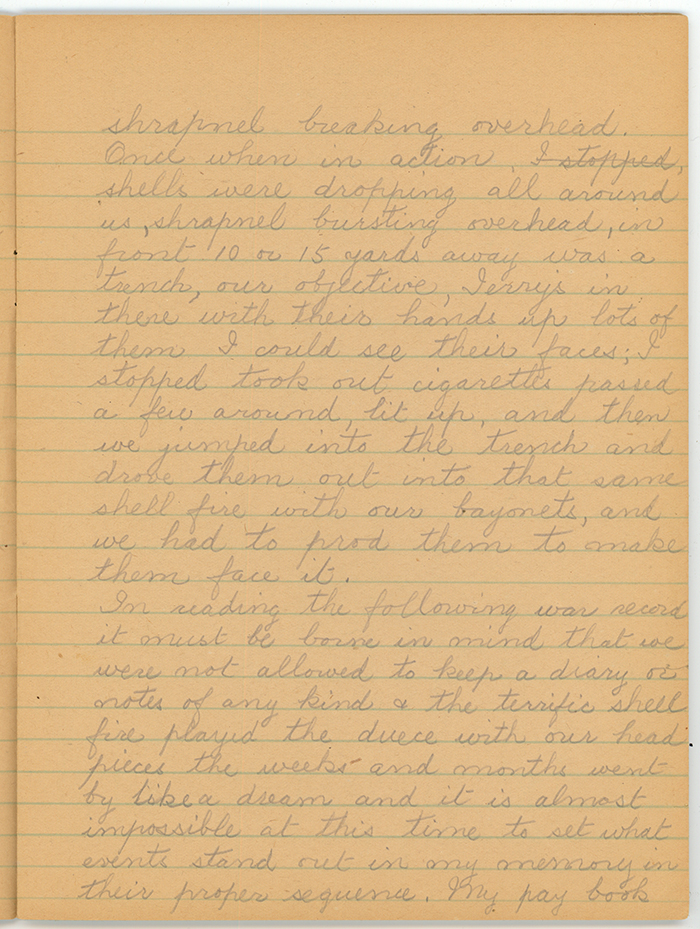
I had nerves of steel, I knew fear but I had a will power that would force my body to walk up to death itself. It was said to be sure death to take the third light off a match. I have often done it with shrapnel breaking overhead. Once when in action, shells were dropping all around us, shrapnel bursting overhead, in front 10 or 15 yards away was a trench, our objective, Jerrys in there with their hands up lots of them. I could see their faces; I stopped took out cigarettes passed a few around lit up, and then we jumped into the trench and drove them out into that same shellfire with our bayonets, and we had to prod them to make them face it.
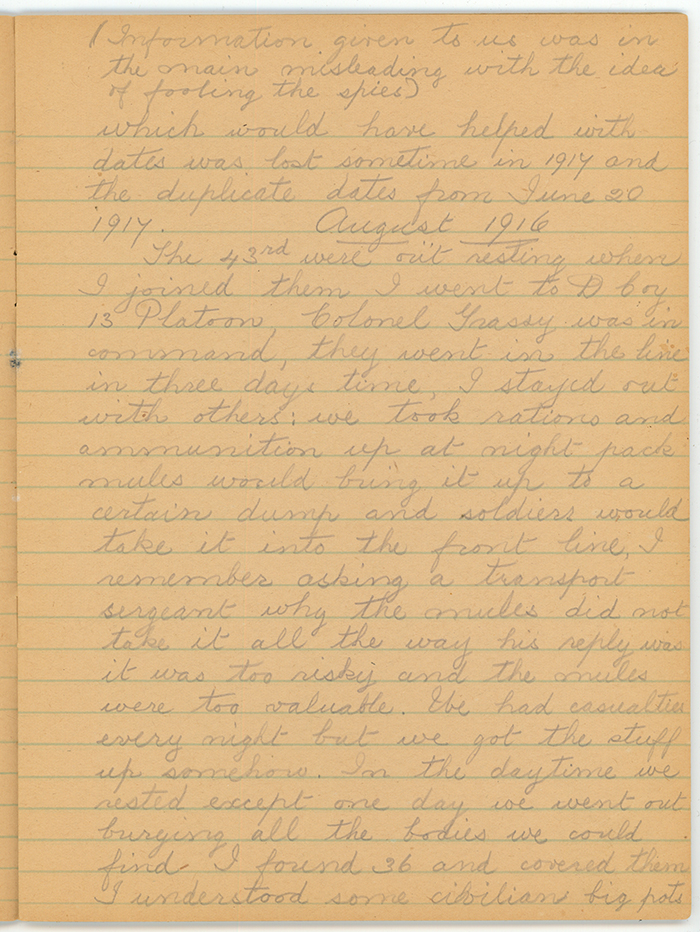
In reading the following war record it must be borne in mind that we were not allowed to keep a diary or notes of any kind and the terrific shell fire played the duece with our head pieces the weeks and months went by like a dream and it is almost impossible at this time to set what events stand out in my memory in their proper sequence. My pay book which would have helped with dates was lost sometime in 1917 and the duplicate dates from June 20, 1917. (Information given to us was in the main misleading with the idea of fooling the spies)
August 1916
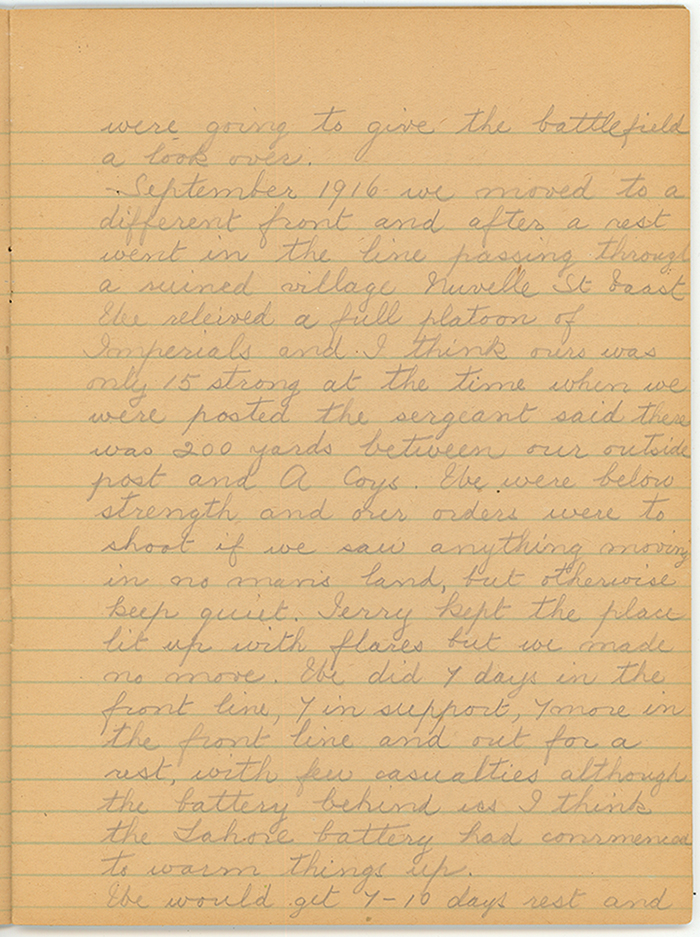
The 43rd were out resting when I joined them. I went to D. Coy 13 Platoon, Colonel Grassy was in command, they went in the line in three days time, I stayed out with others: we took rations and ammunition up at night pack mules would bring it up to a certain dump and soldiers would take it into the front line. I remember asking a transport sergeant why the mules did not take it all the way his reply was it was too risky and the mules were too valuable. We had casualties every night but we got the stuff up somehow. In the daytime we rested except one day we went out burying all the bodies we could find. I found 36 and covered them. I understand some civilian big shots were going to give the battlefield a look over.
September 1916 we moved to a different front and after a rest went in the line passing through a ruined village Nuvelle St. Vaast. We relieved a full platoon of Imperials and I think ours was only 15 strong at the time when we were posted the sergeant said there was 200 yards between our outside post and A Coys. We were below strength and our orders were to shoot if we saw anything moving in no man's land, but otherwise keep quiet. Jerry kept the place lit up with flares but we made no move. We did 7 days in the front line, 7 in support, 7 more in the front line and out for a rest, with few casualties although the battery behind us I think the Lahore battery had commenced to warm things up.
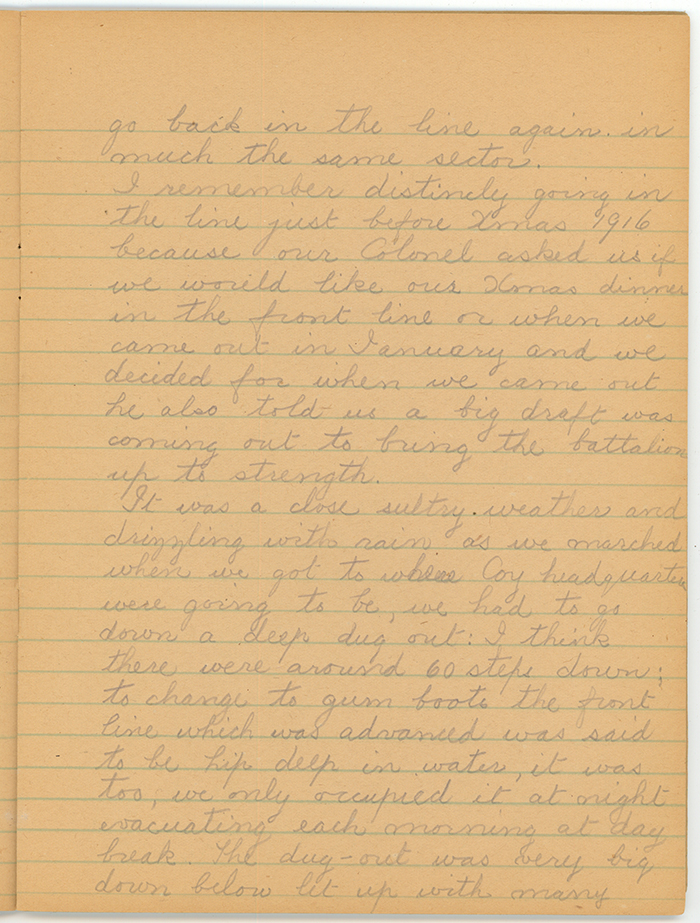
We would get 7-10 days rest and go back in the front line again in much the same sector.
I remember distincly going in the line just before Xmas 1916 because our Colonel asked us if we would like our Xmas dinner in the front line or when we came out in January and we decided for when we came out he also told us a big draft was corning out to bring the battalion up to strength.
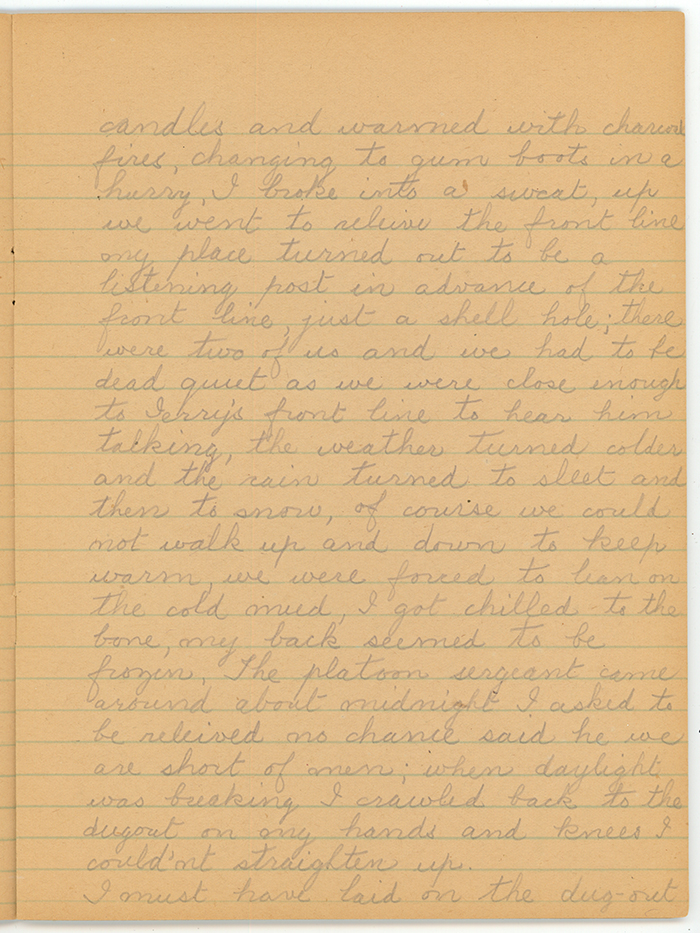
It was a close sultry weather and drizzling with rain as we marched when we got to where Coy headquarters were going to be, we had to go down a deep dug out: I think there were around 60 steps down; to change to gum boots the front line which was advanced was said to be hip deep in water, it was too, we only occupied it at night, evacuating each morning at day break. The dug-out was very big down below lit up with many candles and warmed with charcoal fires, changing to gum boots in a hurry, I broke into a sweat, up we went to relieve the front line my place turned out to be a listening post in advance of the front line, just a shell hole; there were two of us and we had to be dead quiet as we were close enough to Jerry's front line to hear him talking, the weather turned colder and the rain turned to sleet and then to snow, of course we could not walk up and down to keep warm, we were forced to lean on the cold mud, I got chilled to the bone, my back seemed to be frozen. The platoon sergeant came around about midnight I asked to be relieved no chance said he, we are short of men; when daylight was breaking I crawled back to the dugout on my hands and knees I could'nt straighten up.
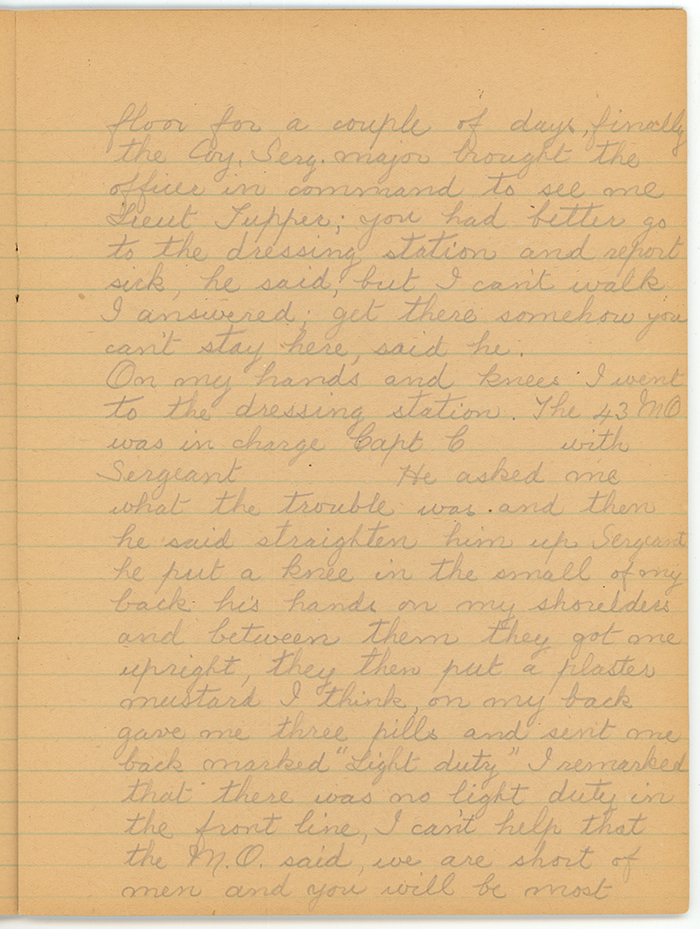
I must have laid on the dug-out floor for a couple of days, finally the Coy. Serg. major brought the officer in command to see me, Lieut. Tupper; you had better go to the dressing station and report sick, he said, but I can't walk I answered; get there somehow you can't stay here, said he.
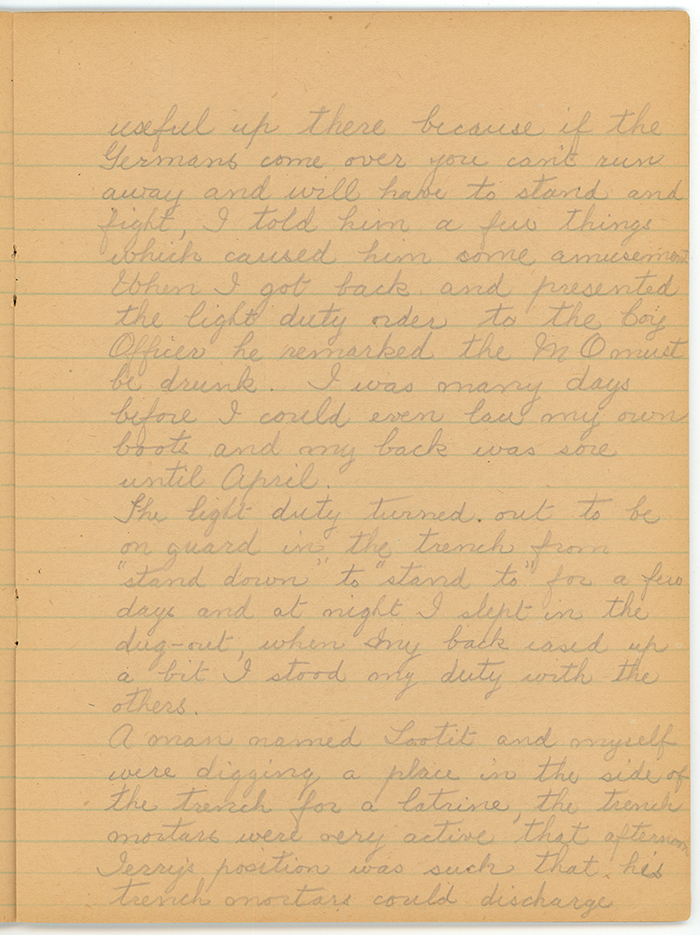
On my hands and knees I went to the dressing station, the 43 MO was in charge. Captain C with Sergeant . He asked me what the trouble was and then he said straighten him up Sergeant, he put a knee in the small of my back his hands on my shoulders and between them they got me upright, they then put a plaster mustard I think, on my back gave me three pills and sent me back marked "Light duty". I remarked that there was no light duty in the front line, I can't help that the M.O. said, we are short of men and you will be most useful up there because if the Germans come over you can't run away and will have to stand and fight, I told him a few things which caused him some amusement. When I got back and presented the light duty order to the Coy Officer he remarked the M.O. must be drunk I was many days before I could even lace my own boots and my back was sore until April.
The light duty turned out to be on guard in the trench from "stand down" to "stand to" for a few days and at night I slept in the dug-out, when my back eased up a bit I stood my duty with the others.
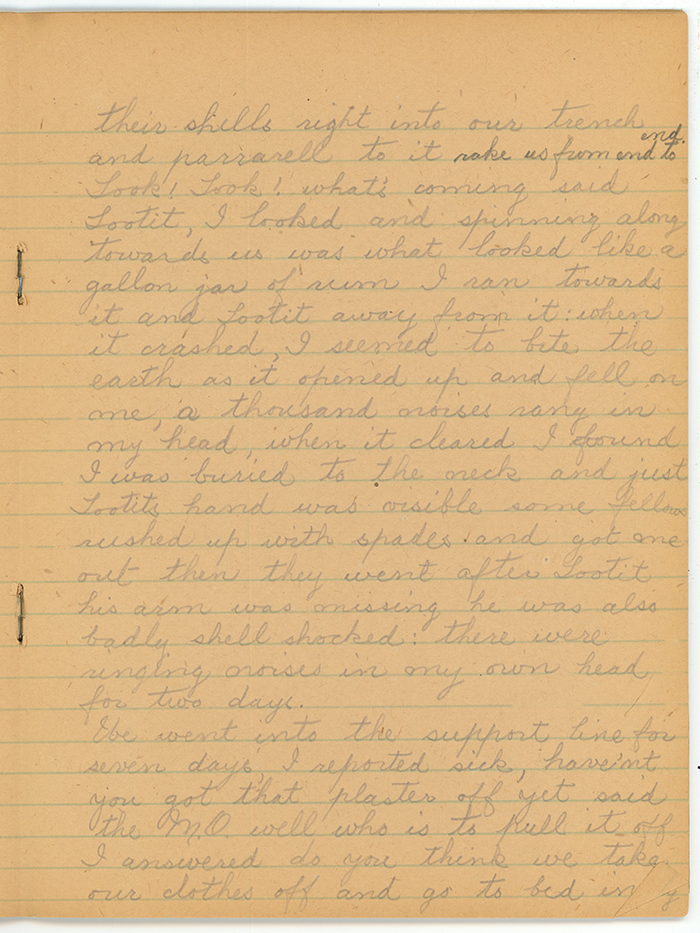
A man named Lootit [?] and myself were digging a place in the side of the trench for a latrine, the trench mortars were very active that afternoon. Jerry's position was such that his trench mortars could discharge their shells right into our trench and parrarell to it rake us from end to end. Look! Look! what's coming said Lootit. I looked and spinning along towards us was what looked like a gallon jar of rum, I ran towards it and Lootit away from it: when it crashed, I seemed to bite the earth as it opened up and fell on me, a thousand noises rang in my head, when it cleared I found I was buried to the neck and just Lootit's hand was visible some fellows rushed up with spades and got me out then they went after Lootit his arm was missing he was also badly shell shocked: there were ringing noises in my own head for two days.
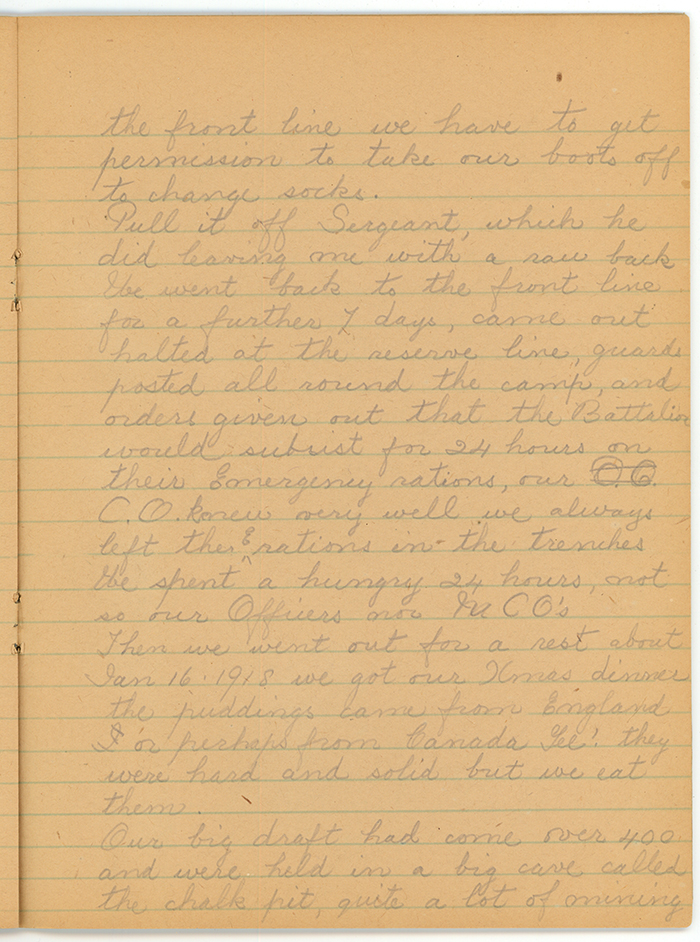
We went into the support line for seven days, I reported sick, haven't you got that plaster off yet said the M.O. well who is to pull it off I answered do you think we take our clothes off and go to bed in the front line we have to get permission to take our boots off to change socks.
Pull it off Sergeant, which he did leaving me with a raw back We went back to the front line for a further 7 days, came out, halted at the reserve line, guards posted all round the camp, and orders given out that the Battalion would subsist for 24 hours on their Emergency rations, our C.O. knew very well we always left the E-rations in the trenches. We spent a hungry 24 hours not so our officers nor the COs. Then we went out for a rest about Jan 16, 1918 we got our Xmas dinner the puddings came from England or perhaps from Canada Gee they were hard and solid but we eat them.
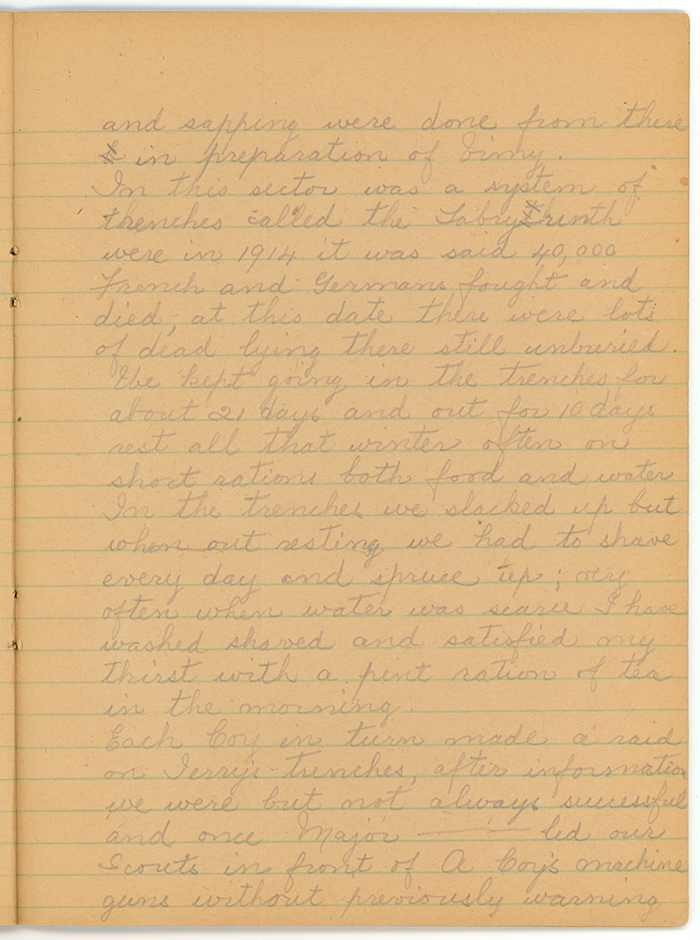
Our big draft had come over 400 and were held in a big cave called the chalk pit quite a lot of mining and sapping were done from these in preparation of Vimy.
In this sector was a system of trenches called the Labryinth were in 1914 it was said 40,000 French and Germans fought and died, at this date there were lots of dead lying there still unburied. We kept going in the trenches for about 21 days and out for 10 days rest all that winter often on short rations both food and water. In the trenches we slacked up but when out resting we had to shave every day and spruce up; very often when water was scarce I have washed shaved and satisfied my thirst with a pint ration of tea in the morning.
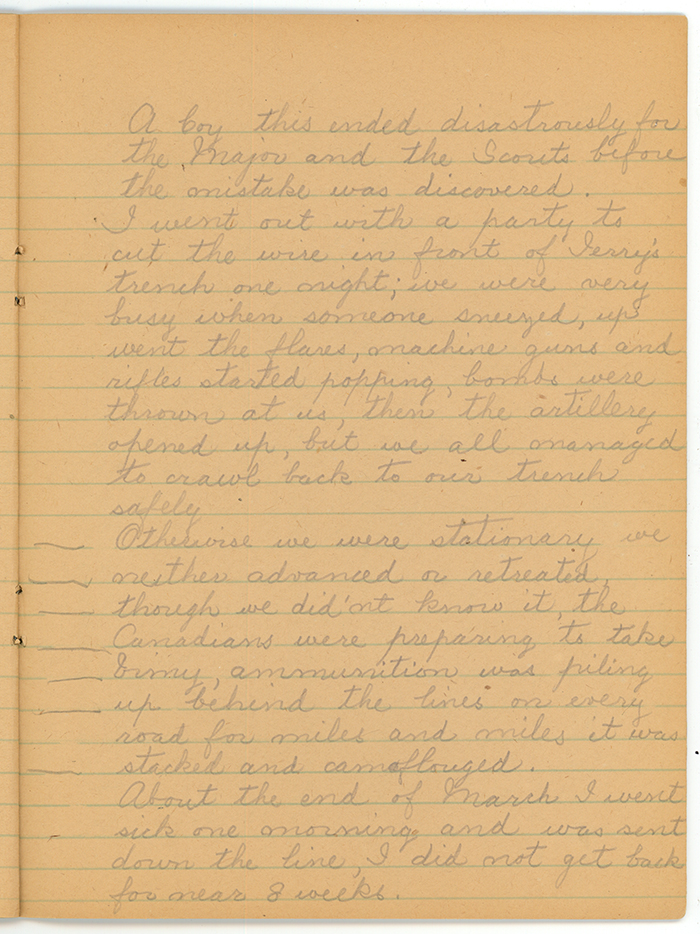
Each Coy in turn made a raid on Jerry's trenches, after information we were but not always successful and once Major led our Scouts in front of A Coy's machine guns without previously warning A Coy. This ended disastrously for the Major and the Scouts before the mistake was discovered. I went out with a party to cut the wire in front of Jerry's trench one night; we were very busy when someone sneezed, up went the flares, machine guns and rifles started popping, bombs were thrown at us, the artillery opened up, but we all managed to crawl back to our trench safely.
Otherwise we were stationary. We neither advanced or retreated, though we did'nt know it, the Canadians were preparing to take Vimy, ammunition was piling up behind the lines on every road for miles and miles it was stacked and camoflouged.
About the end of March I went sick one morning and was sent down the line, I did not get back for near 8 weeks.
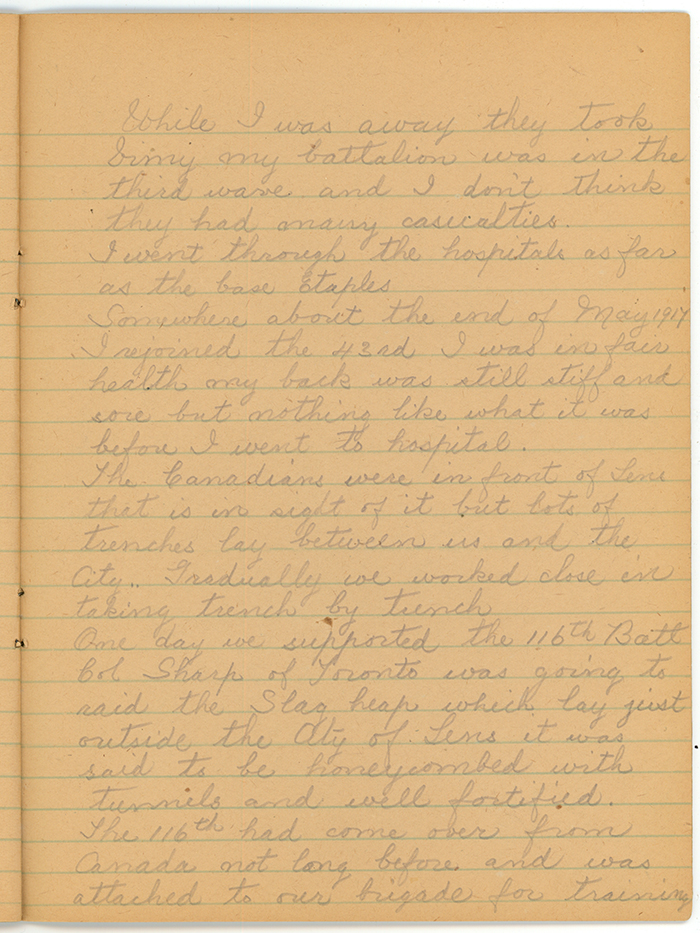
While I was away they took Vimy. My battalion was in the third wave and I don't think they had many casualties. I went through the hospitals as far as the base Etaples.
Somewhere about the end of May 1917 I rejoined the 43rd. I was in fair health my back was still stiff and sore but nothing like what it was before I went to hospital.
The Canadians were in front of Lens that is in sight of it but lots of trenches lay between us and the City. Gradually we worked close in taking trench by trench.
One day we supported the 116th Batt Col Sharp of Toronto was going to raid the Slag heap which lay just outside the City of Lens it was said to be honeycombed with tunnels and well fortified. The 116th had come over from Canada not long before and was attached to our brigade for training.
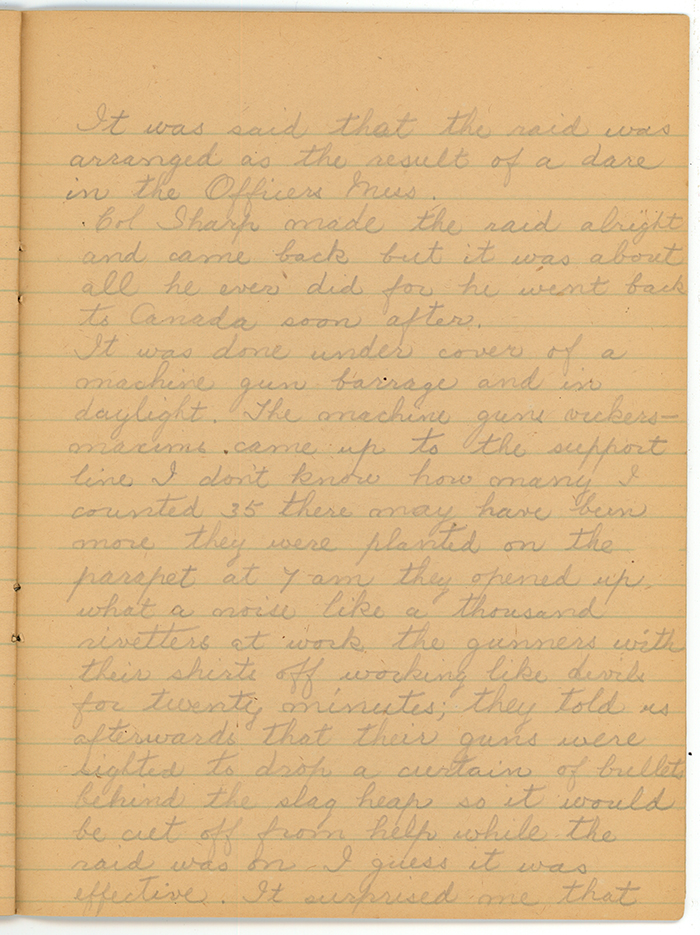
It was said that the raid was arranged as the result of a dare in the Officers Mess.
Col Sharp made the raid alright and came back but it was about all he ever did for he went back to Canada soon after.
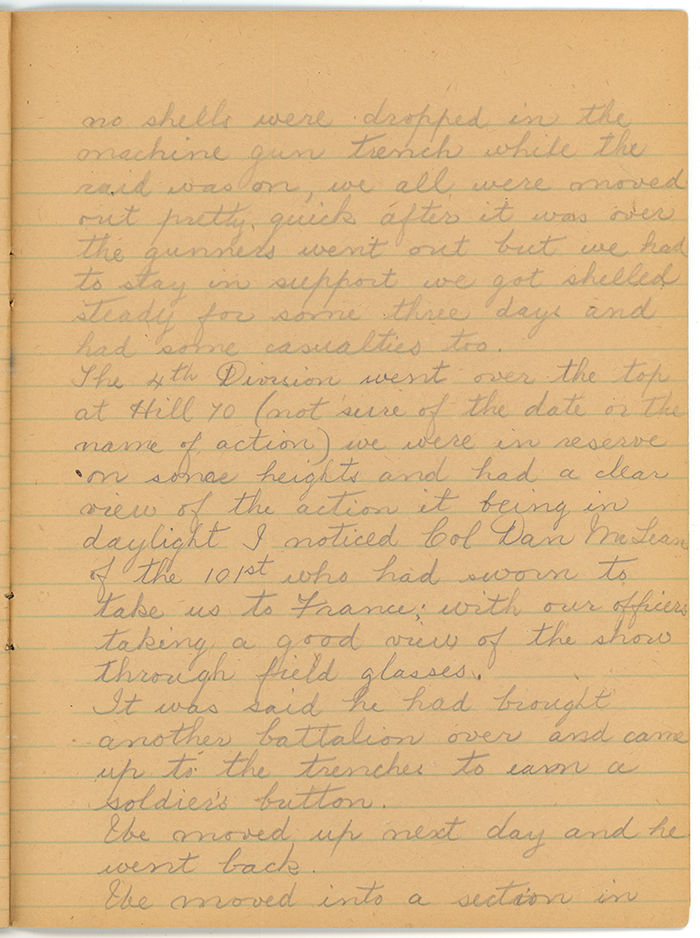
It was done under cover of a machine gun barrage and in daylight. The machine guns vickers-maxims came up to the support line I don't know how many. I counted 35 there may have been more they were planted on the parapet at 7 am they opened up what a noise like a thousand rivetters at work the gunners with their shirts off working like devils for twenty minutes; they told us afterwards that their guns were sighted to drop a curtain of bullets behind the slag heap so it would be cut off from help while the raid was on. I guess it was effective. It surprised me that no shells were dropped in the machine-gun trench while the raid was on, we all were moved out pretty quick after it was over the gunners went out but we had to stay in support we got shelled steady for some three days and had some casualties too.
The 4th Division went over the top at Hill 70 (not sure of the date or the name of action) we were in reserve on some heights and had a clear view of the action it being in daylight. I noticed Col Dan McLean of the 101st who had sworn to take us to France; with our officers taking a good view of the show through field glasses.
It was said he had brought another battalion over and came up to the trenches to earn a soldier's button.
We moved up next day and he went back.
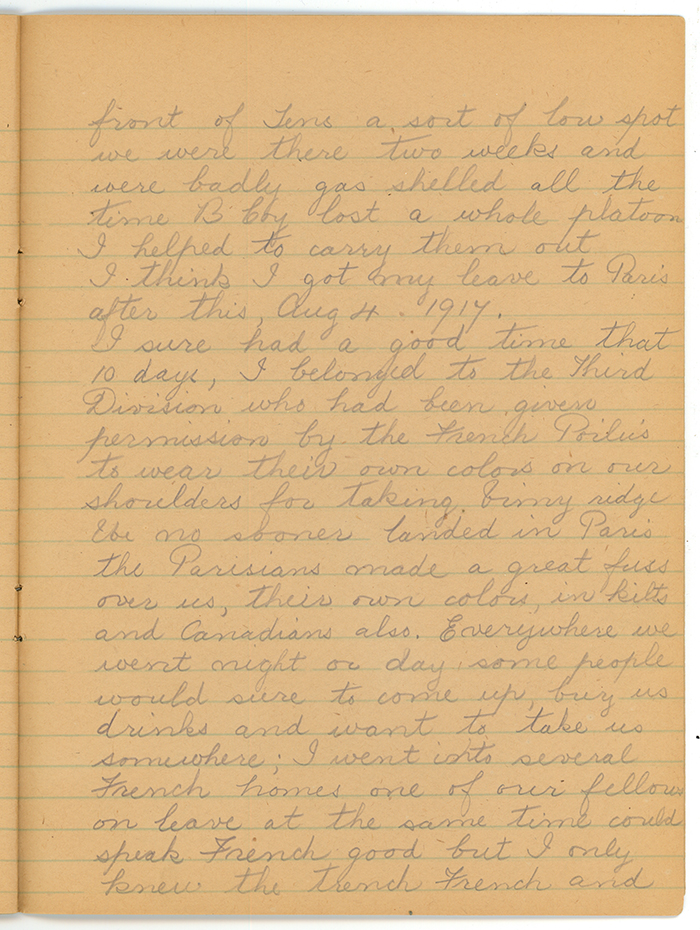
We moved into a section in front of Lens a sort of low spot we were there two weeks and were badly gas shelled all the time. B Coy lost a whole platoon. I helped to carry them out. I think I got my leave to Paris after this, Aug 4, 1917.
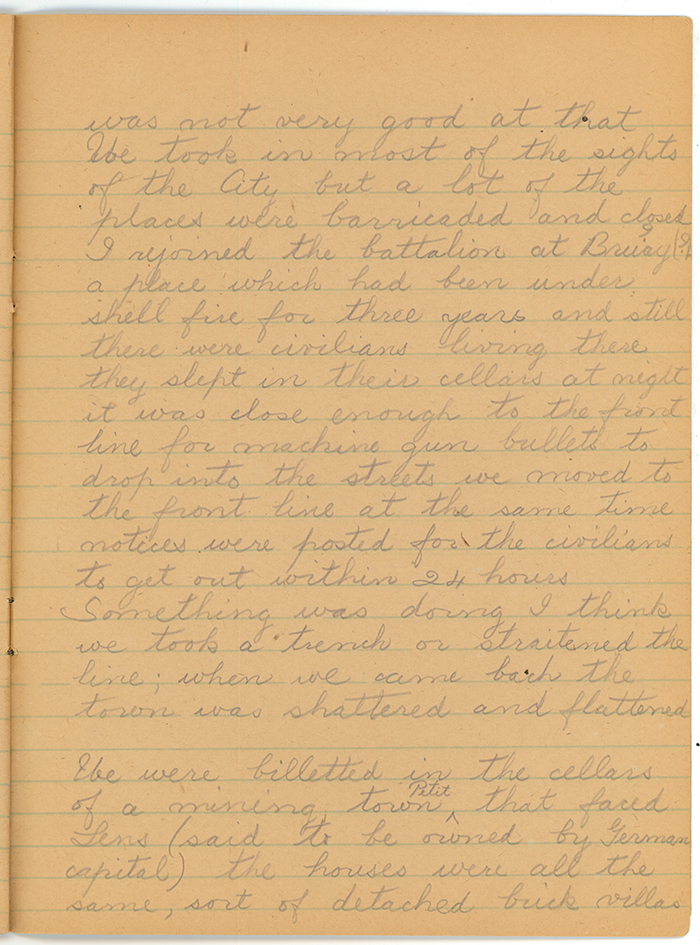
I sure had a good time that 10 days, I belonged to the Third Division who had been given permission by the French Poilu's to wear their own colors on our shoulders for taking Vimy ridge We no sooner landed in Paris the Parisians made a great fuss over us, their own colors, in kilts and Canadians also. Everywhere we went night or day some people would sure to come up, buy us drinks and want to take us somewhere; I went into several French homes one of our fellows on leave at the same time could speak French good but I only knew the trench French and was not very good at that We took in most of the sights of the City but a lot of the places were barricaded and closed.
I rejoined the battalion at Bruay a place which had been under shell fire for three years and still there were civilians living there they slept in their cellars at night it was close enough to the front line for machine gun bullets to drop into the street we moved to the front line at the same time notices were posted for the civilians to get out within 24 hours.
Something was doing I think we took a trench or straitened the line; when we came back the town was shattered and flattened.
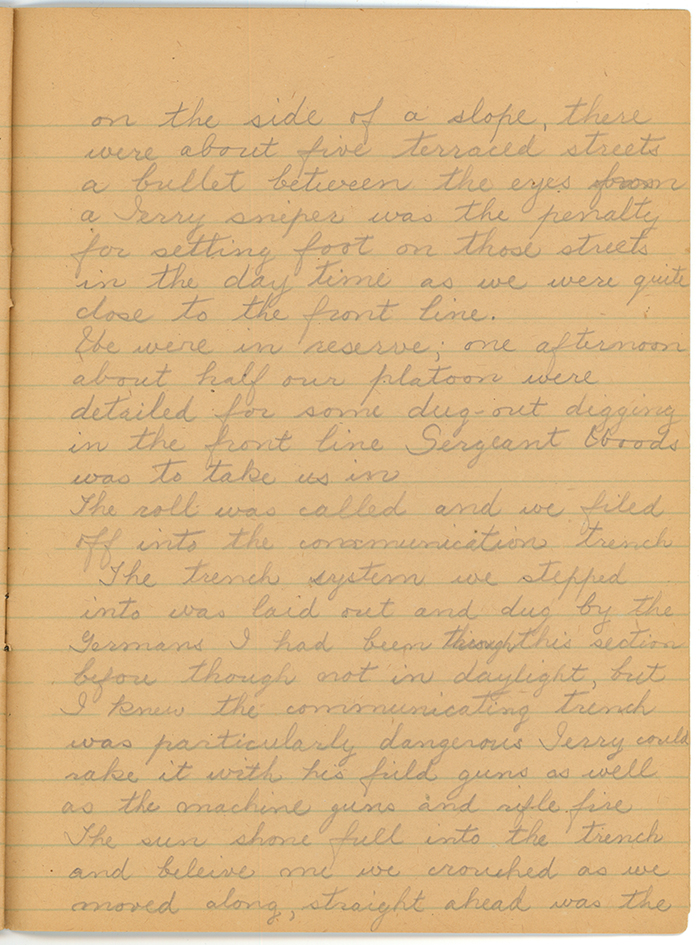
We were billeted in the cellars of a mining town Petit that faced Lens (said to be owned by German capital) the houses were all the same, sort of detached brick villas on the side of a slope, there were about five terraced streets a bullet between the eyes from a Jerry sniper was the penalty for setting foot on those streets in the daytime as we were quite close to the front line.
We were in reserve; one afternoon about half our platoon were detailed for some dug-out digging in the front line. Sergeant Woods was to take us in.
The roll was called and we filed off into the communications trench.
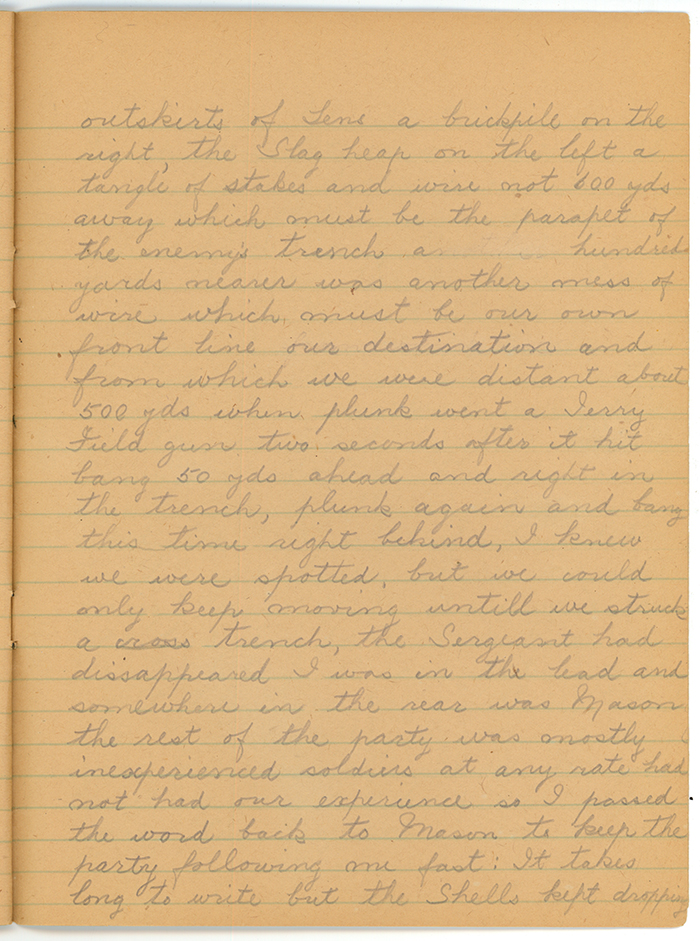
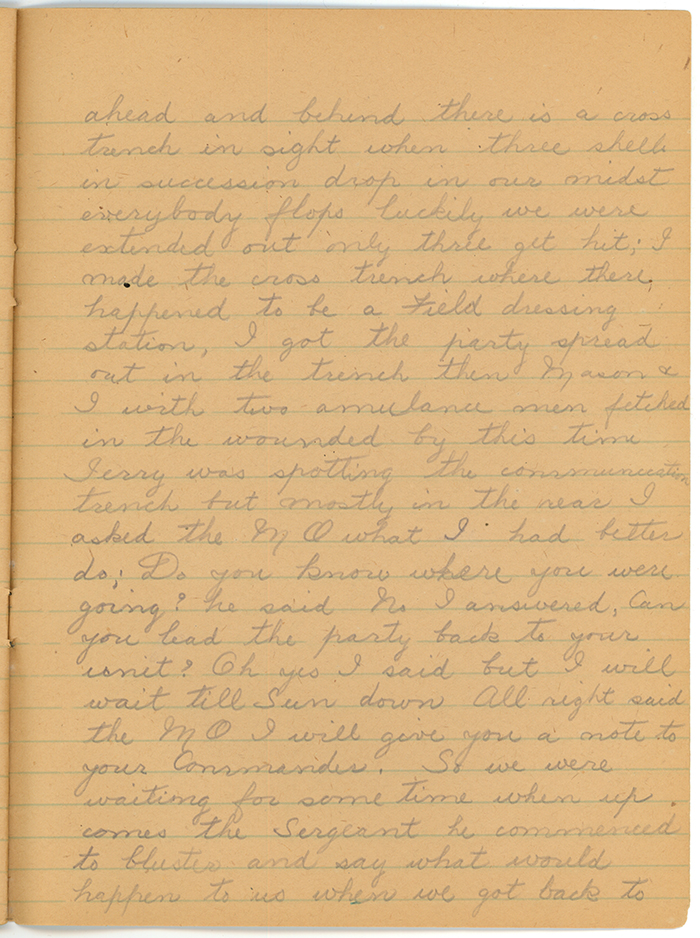
The trench system we stepped into was laid out and dug by the Germans I had been through this section before though not in daylight, but I knew the communicating trench was particularly dangerous Jerry could rake it with his field guns as well as the machine guns and rifle fire The sun shone full into the trench and believe me we crouched as we moved along, straight ahead was the outskirts of Lens a brick pile on the right, the Slag heap on the left a tangle of stakes and wire not 600 yds away which must be the parapet of the enemy's trench, a hundred yards nearer was another mess of wire which must be our own front line our destination and from which we were distant about 500 yards when plunk went a Jerry field gun two seconds after it hit bang 50 yds ahead and right in the trench, plunk again and bang, this time right behind, I knew we were spotted, but we could only keep moving until we struck a cross trench, the Sergeant had disappeared I was in the lead and somewhere in the rear was Mason the rest of the party was mostly inexperienced soldiers at any rate had not had our experience so I passed the word back to Mason to keep the party following me fast: It takes long to write but the Shells kept dropping ahead and behind there is a cross trench in sight when three shells in succession drop in our midst everybody flops luckily we were extended out only three get hit; I made the cross trench where there happened to be a Field dressing station, I got the party spread out in the trench then Mason and I with two amulance men fetched in the wounded by this time Jerry was spotting the communication trench but mostly in the rear. I asked the M.O.
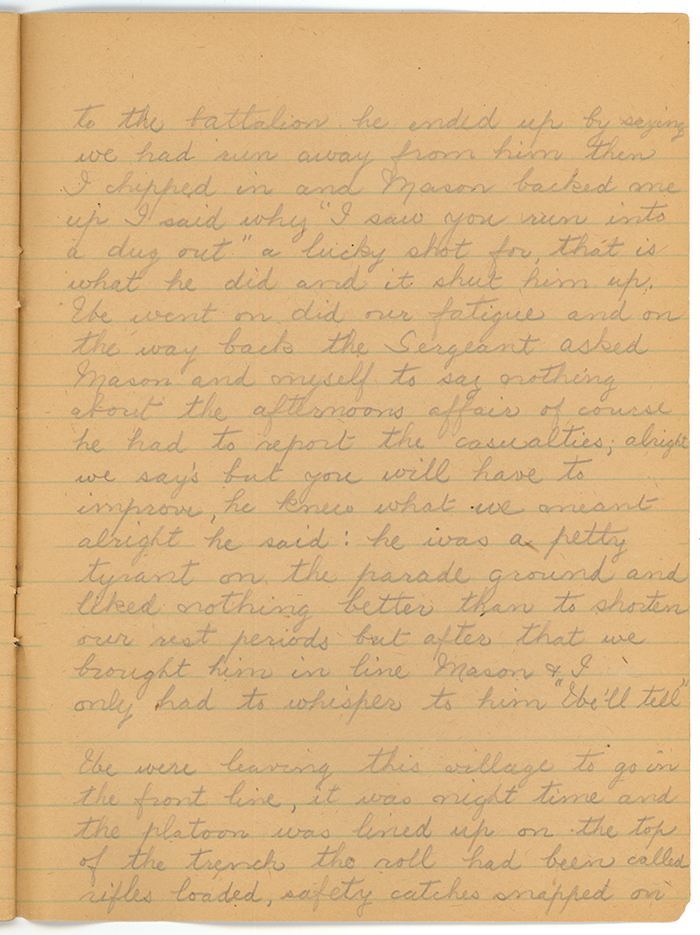
what I had better do; Do you know where you were going he said. No I answered, Can you lead the party back to your unit? Oh yes I said but I will wait till Sun down. All right said the M.O. I will give you a note to your Commander. So we were waiting for some time when up comes the Sergeant. He commenced to bluster and say what would happen to us when we got back to the battalion he ended up by saying we had run away from him then I chipped in and Mason backed me up I said why "I saw you run into a dug-out" a lucky shot for, that is what he did and it shut him up. We went on did our fatigue and on the way back the Sergeant asked Mason and myself to say nothing about the afternoons affair of course he had to report the casualties; alright we say's but you will have to improve, he knew what we meant alright he said: he was a petty tyrant on the parade ground and liked nothing better than to shorten our rest periods but after that we brought him in line Mason and I only had to whisper to him "We'll tell".
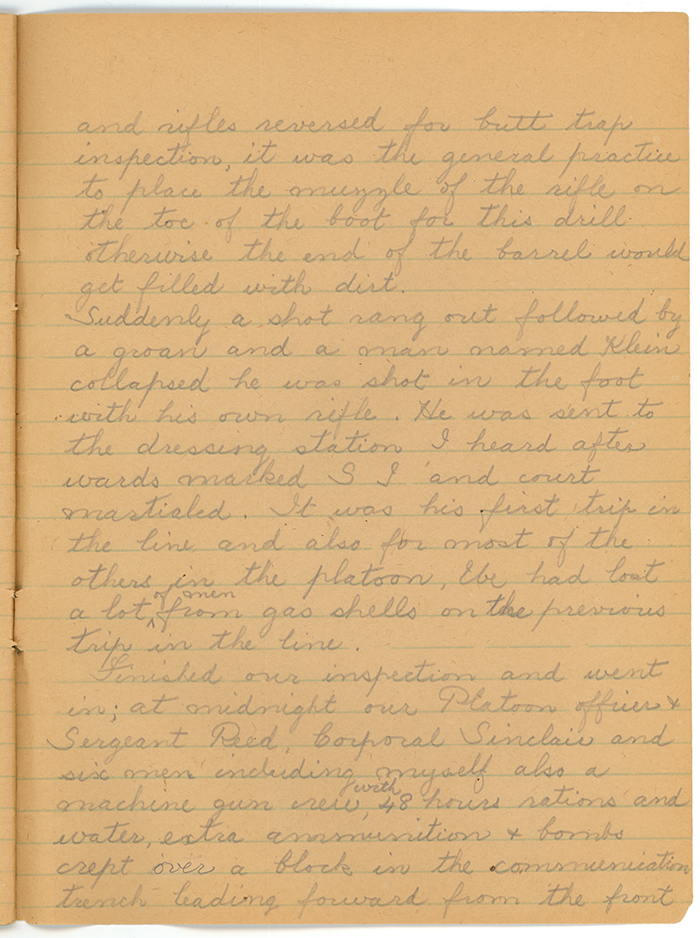
We were leaving this village to go in the front line, it was night time and the platoon was lined up on the top of the trench the roll had been called, rifles loaded, safety catches snapped on rifles reversed for butt trap inspection, it was the general practice to place the muzzle of the rifle on the toe of the boot for this drill, otherwise the end of the barrel would get filled with dirt.
Suddenly a shot rang out followed by a groan and a man named Klein collapsed he was shot in the foot with his own rifle. He was sent to the dressing station. I heard afterwards marked S I and court martialed. It was his first trip in the line and also for most of the others in the platoon. We had lost a lot of men from gas shells on the previous trip in the line.
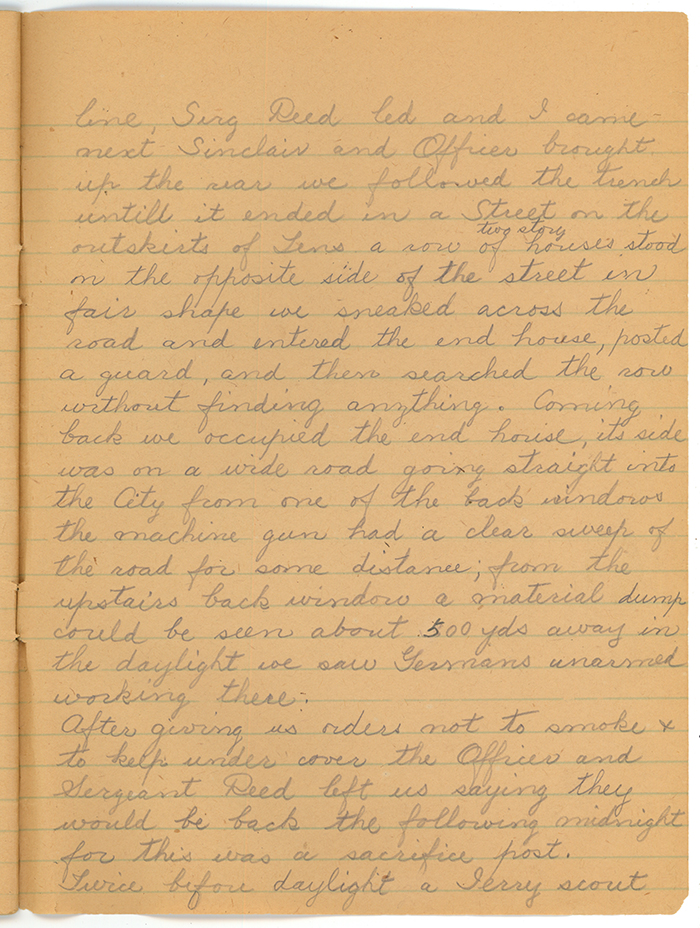
Finished our inspection and went in; at midnight our Platoon officer and Sergeant Reed, Corporal Sinclair and six men including myself also a machine gun crew with 48 hours rations and water, extra ammunition and bombs crept over a block in the communication trench leading forward from the front line, Serg. Reed led and I came next Sinclair and Officer brought up the rear we followed the trench untill it ended in a Street on the outskirts of Lens a row of two story houses stood on the opposite side of the street in fair shape we sneaked across the road and entered the end house, posted a guard, and then searched the row without finding anything. Coming back we occupied the end house, its side was on a wide road going straight into the City from one of the back windows the machine gun had a clear sweep of the road for some distance; from the upstairs back window a material dump could be seen about 500 yds away in the daylight we saw Germans unarmed working there.
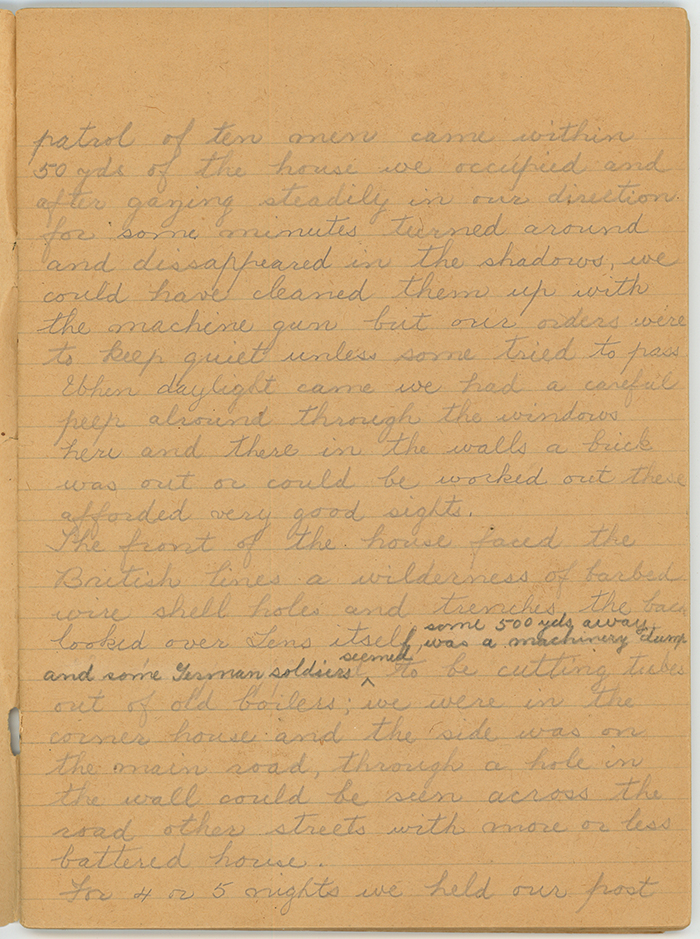
After giving us orders not to smoke and to keep under cover the Officer and Sergeant Reed left us saying they would be back the following midnight for this was a sacrifice post. Twice before daylight a Jerry scout patrol of ten men came within 50 yards of the house we occupied and after gazing steadily in our direction for some minutes turned around and disappeared in the shadows, we could have cleaned them up with the machine gun but our orders were to keep quiet unless some tried to pass. When daylight came we had a careful peep around through the windows here and there in the walls a brick was out or could be worked out these afforded very good sights.
The front of the house faced British lines. A wilderness of barbed wire, shell holes and trenches, the back looked over Lens itself some 500 yds away was a machinery dump and some German soldiers seems to be cutting tubes out of old boilers; we were in the comer house the side was on the main road, through a hole in the wall could be seen across the road other streets with more or less battered house.
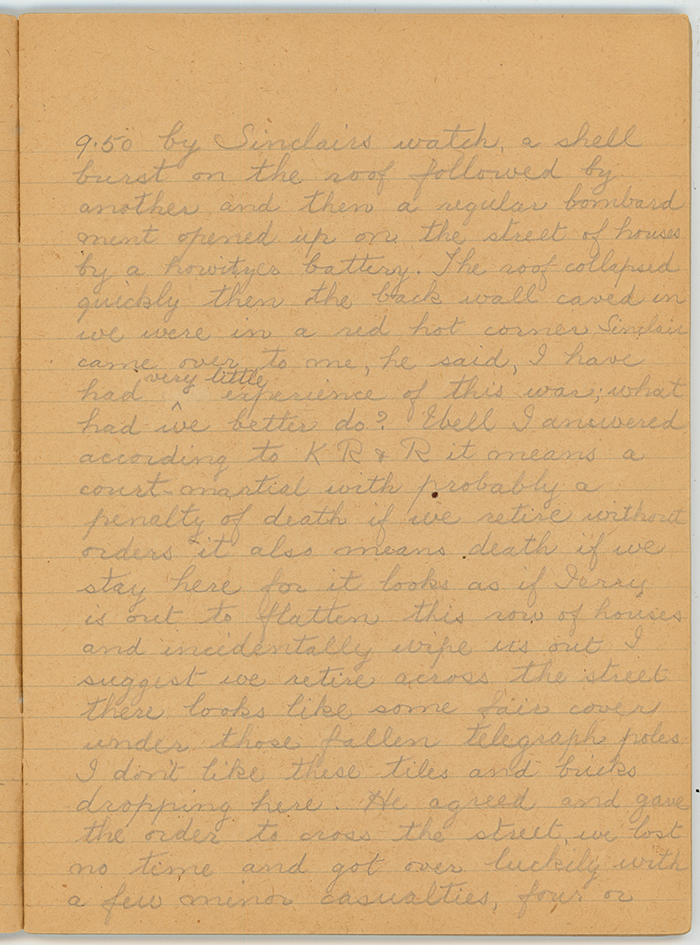
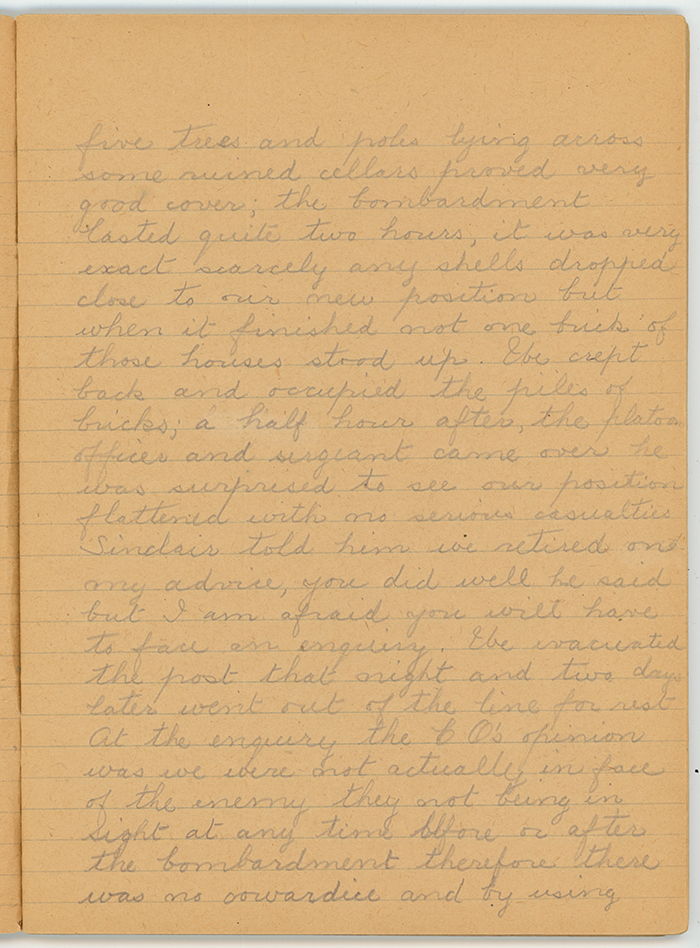
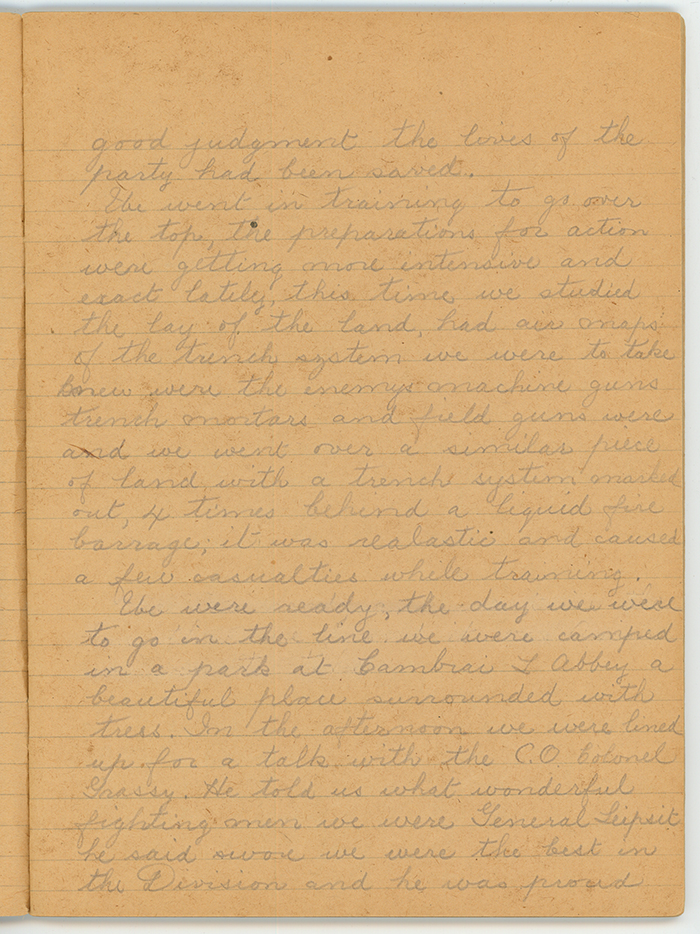
For 4 or 5 nights we held our post without discovery when one evening about 9pm an enemy patrol came down and halted on both sides of the road their leaders were not more than 30 paces away when they stopped and I counted 20 men, our fingers were on the triggers and a few paces more would have brought them to the mark at which we had agreed to open fire. Some time they stood there and the silence in that vicinity could be felt except for an occasional report from gun or shell in the distance. Had they suspected the houses were occupied they would hardly have stood upright within pistol range looking at them, and yet it was their territory and their job as scouts to see that the enemy was'nt in occupation. They did not have the nerve to come and see, instead turned about and filed into the darkness at 9:20pm; they had other ways: thirty minutes after 9:50 by Sinclairs watch, a shell burst on the roof followed by another and then a regular bombardment opened up on the street of houses by a howitzer battery. The roof collapsed quickly then the back wall caved in we were in a red hot corner. Sinclair came over to me, he said, I have had very little experience of this war, what had we better do? Well I answered according to K R and R it means a court-martial with probably a penalty of death if we retire without orders it also means death if we stay here for it looks as if Jerry is out to flatten this row of houses and incidentally wipe us out I suggest we retire across the street there looks like some fair cover under those fallen telegraph poles I don't like these tiles and bricks dropping here. He agreed and gave the order to cross the street, we lost no time and got over luckily with a few minor casualties four or five trees and poles lying across some ruined cellars proved very good cover; the bombardment lasted quite two hours, it was very exact scarcely any shells dropped close to our new position but when it finished not one of those houses stood up, we crept back and occupied the piles of bricks; a half hour after, the platoon officer and sergeant came over he was surprised to see our position flattened with no serious casualties. Sinclair told him we retired on my advice, you did well he said but I am afraid you will have to face an enquiry. We evacuated the post that night and two days later went out of the line for rest. At the enquiry the C.O.'s opinion was that we were not actually in face of the enemy they not being in sight at any time before or after the bombardment therefore there was no cowardice and by using good judgment the lives of the party had been saved.
We went in training to go over the top, the preparations for action were getting more intensive and exact lately, this time we studied the lay of the land, had our maps of the trench system we were to take, knew were the enemy's machine guns trench mortars field guns were and we went over a similar piece of land with a trench system marked out 4 times behind a liquid fire barrage; it was realistic and caused a few casualties while training.
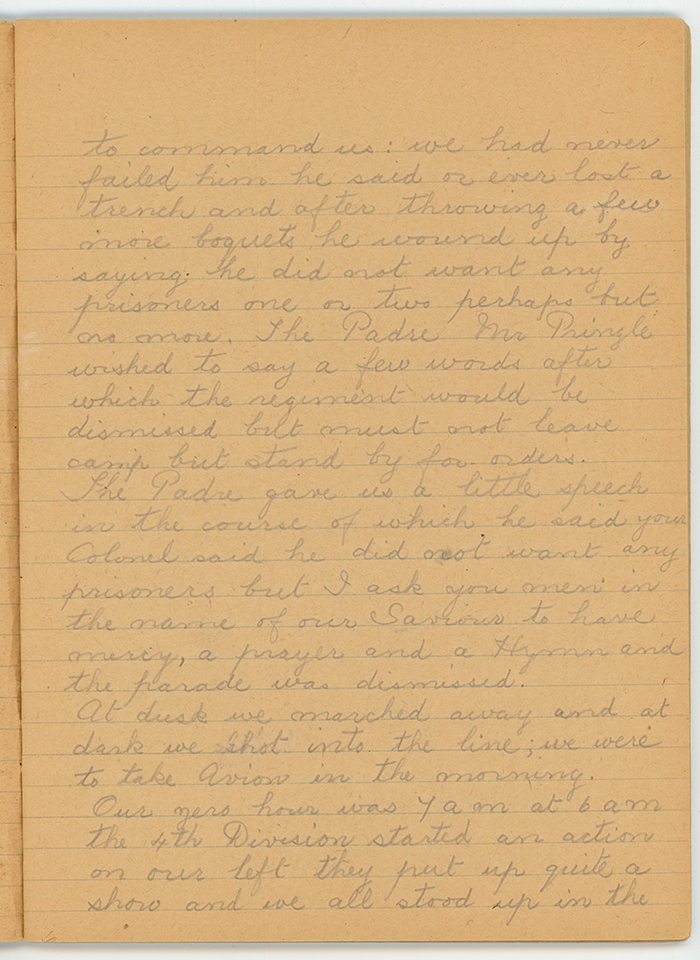
We were ready; the day we were to go in the line we were camped in a park at Cambrai L'Abbey a beautiful place surrounded with trees. In the afternoon we were lined up for a talk with the C.O. Colonel Grassy. He told us what wonderful fighting men we were. General Leipsit he said swore we were the best in the Division and he was proud to command us: we had never failed him he said or ever lost a trench and after throwing a few more boquets he wound up by saying he did not want any prisoners, one or two perhaps but no more. The Padre Mr. Pringle wished to say a few words after which the regiment would be dismissed but must not leave camp but stand by for orders.
The Padre gave us a little speech in the course of which he said your Colonel said he did not want any prisoners but I ask you men in the name of our Saviour to have mercy, a prayer and a Hymn and the parade was dismissed.
At dusk we marched away and at dark we shot into the line; we were to take Avion in the morning.
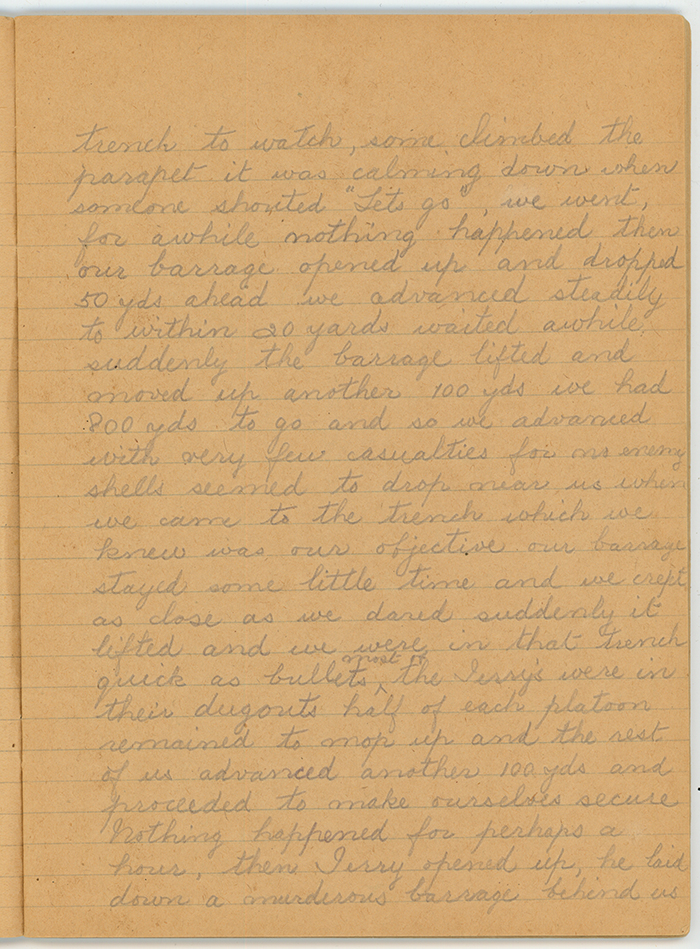
Our zero hour was 7am at 6am the 4th Division started an action on our left they put up quite a show and we all stood up in the trench to watch, some climbed the parapet it was calming down when someone shouted "Let's go", we went, for a while nothing happened then our barrage opened up and dropped 50 yards ahead we advanced steadily to within 20 yards waited a while suddenly the barrage lifted and moved up another 100 yds we had 800 yds to go and so we advanced with very few casualties for no enemy shells seemed to drop near us when we came to the trench which we knew was our objective our barrage stayed some little time and we crept as close as we dared suddenly it lifted and we were in that trench quick as bullets most of the Jerrys were in their dugouts half of each platoon remained to mop up and the rest of us advanced another 100 yds and proceeded to make ourselves secure .
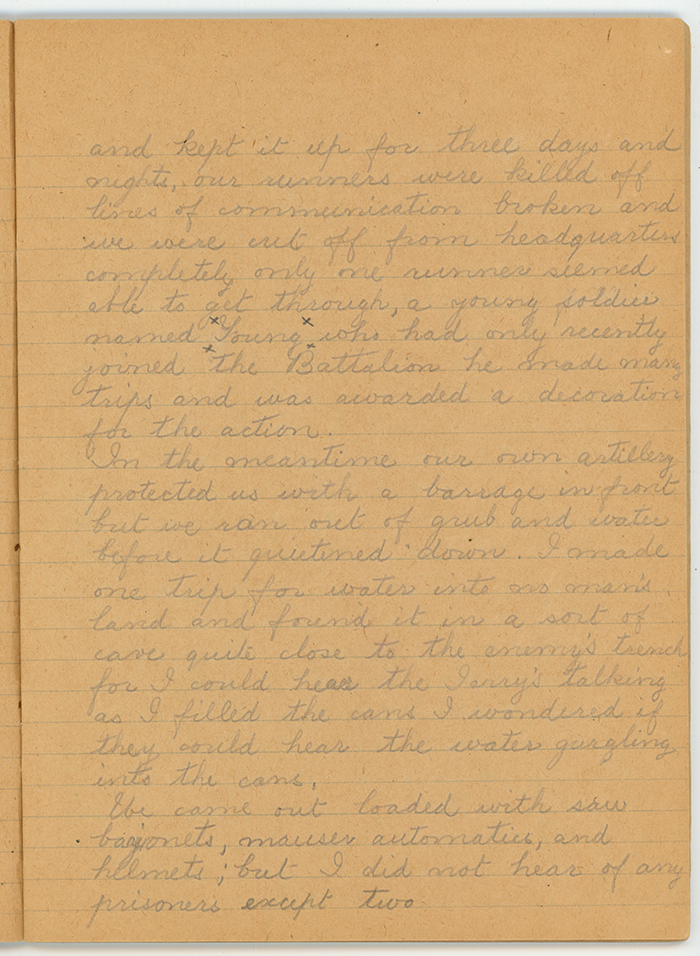
Nothing happened for perhaps an hour, then Jerry opened up, he laid down a murderous barrage behind us and kept it up for three days and nights, our runners were killed off lines of communication broken and we were cut off from headquarters completely only one runner seemed able to get through, a young soldier named Young who had only recently joined the Battalion he made many trips and was awarded a decoration for the action.
In the meantime our own artillery protected us with a barrage in front but we ran out of grub and water before it quietened down. I made one trip for water into no man's land and found it in a sort of cave quite close to the enemy's trench for I could hear the Jerry's talking as I filled the cans. I wondered if they would hear the water gurgling into the cans.
We came out loaded with saw bayonets, Mauser automatics, and helmets; but I did not hear of any prisoners except two.
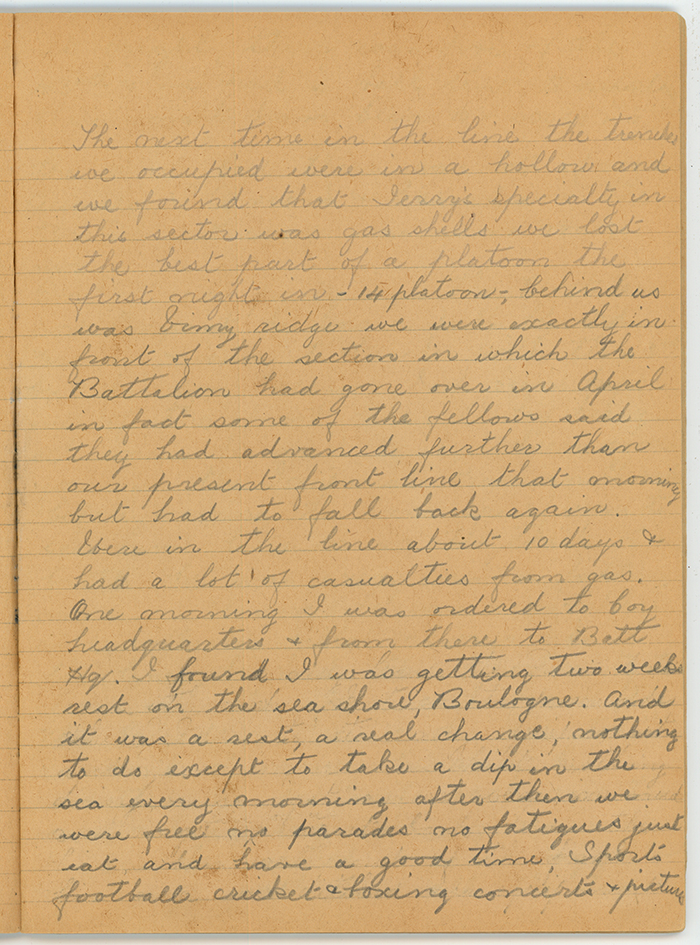
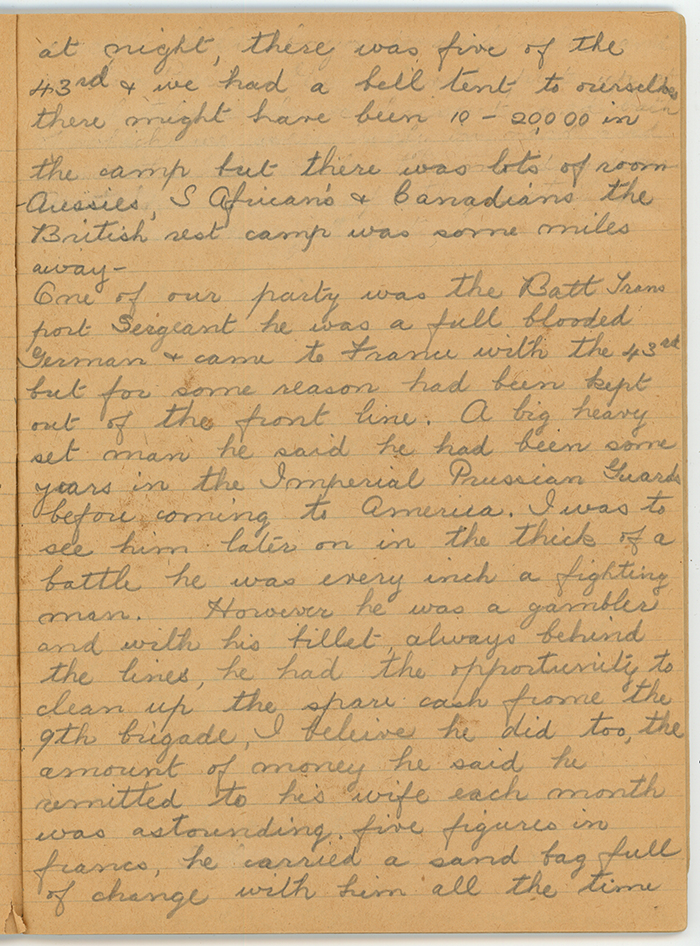
The next time in the line the trenches we occupied were in a hollow and we found that Jerry's specialty in this sector was gas shells we lost the best part of a platoon the first night in -14 platoon - behind us was Vimy Ridge we were exactly in front of the section in which the Battalion had gone over in April in fact some of the fellows said they had advanced further than our present front line that morning but had to fall back again. Were in the line about 10 days and had a lot of casualties from gas. One morning I was ordered to Coy. Headquarters and from there to Batt HQ. I found I was getting two weeks rest on the sea shore, Boulogne. And it was a rest, a real change, nothing to do except to take a dip in the sea every morning after then we were free no parades no fatigues just eat and have a good time. Sports, football, cricket and boxing, concerts and pictures at night, there was five of the 43rd and we had a bell tent to ourselves there might have been 10-20,000 in the camp but there was lots of room Aussies, S Africans and Canadians the British rest camp was some miles away.
One of our party was the Batt Transport Sergeant he was a full-blooded German and came to France with the 43rd but for some reason had been kept out of the front line. A big heavyset man he said he had been some years in the Imperial Prussian Guards before coming to America. I was to see him later on in the thick of a battle he was every inch a fighting man. However, he was a gambler and with his billet always behind the lines, he had the opportunity to clean up the spare cash from the 9th brigade, I believe he did too, the amount of money he said he remitted to his wife each month was astounding, five figures in francs, he carried a sandbag full of change with him all the time.
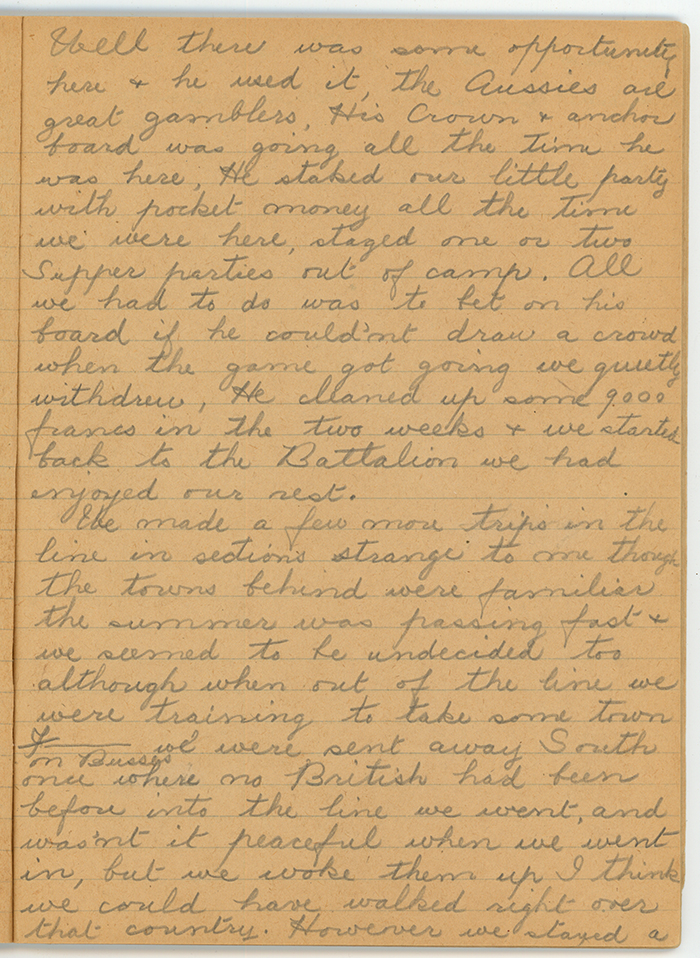
Well, there was some opportunity here and he used it, the Aussies are great gamblers. His Crown and anchor board was going all the time he was here. He staked our little party with pocket money all the time we were here, staged one or two Supper parties out of camp. All we had to do was to bet on his board if he could'nt draw a crowd when the game got going we quietly withdrew. He cleaned up some 9000 francs in the two weeks and we started back to the Battalion we had enjoyed our rest.
We made a few more trips in the line in sections strange to me though the towns behind were familiar the summer was passing fast and we seemed to be undecided too although when out of the line we were training to take some town – we were sent away South once on Busses where no British had been before into the line we went, and was’nt it peaceful when we went in, but we woke them up I think we could have walked right over that country. However we stayed a few days and then rode back to Cambrai L’Abbe, here we had two weeks rest.
[end of memoir]
Original Scans